
Publications / International Journal of Innovative and Multidisciplinary Research / Vol. 1, No. 4 (2026)
Abstract
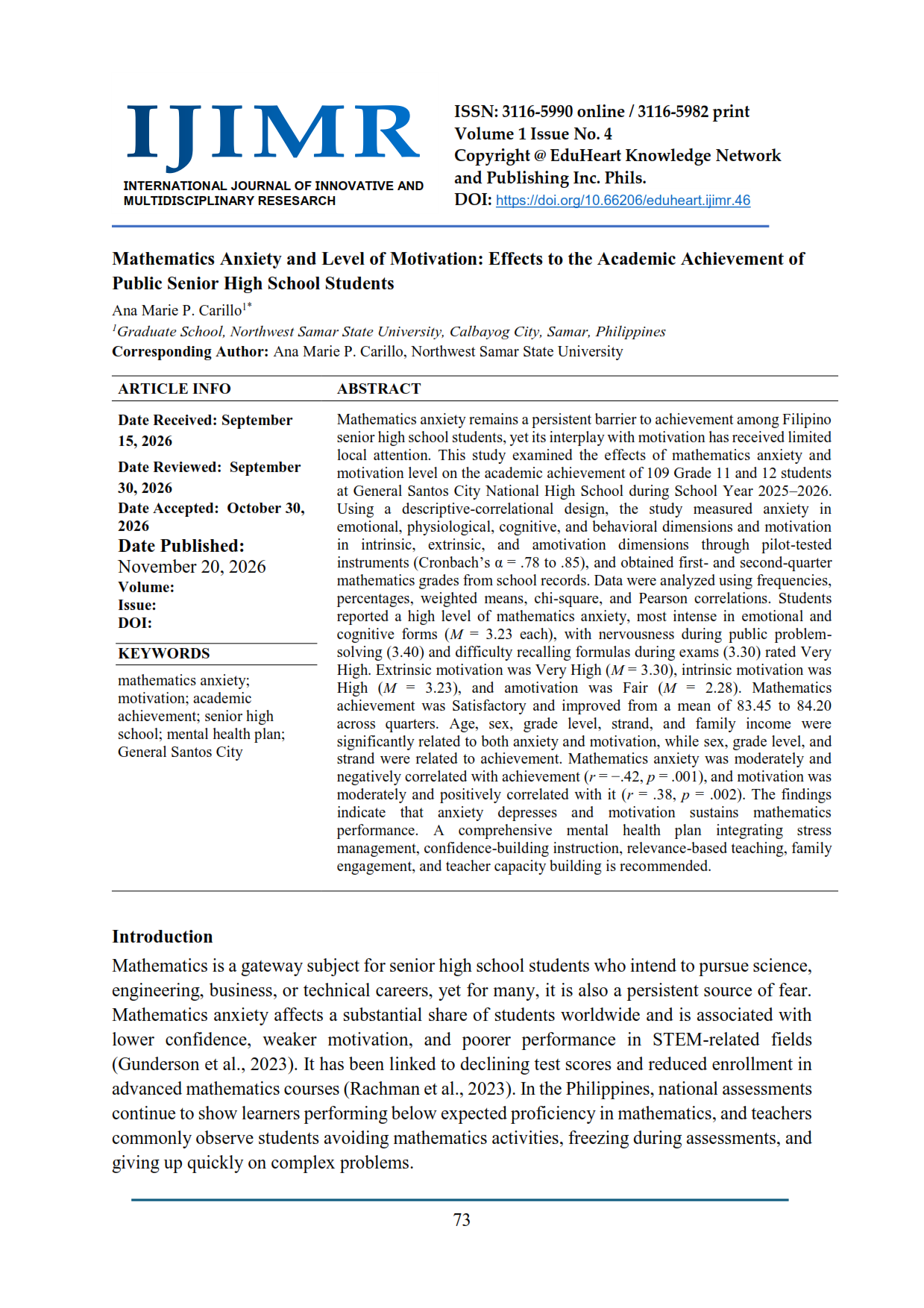
Mathematics anxiety remains a persistent barrier to achievement among Filipino senior high school students, yet its interplay with motivation has received limited local attention. This study examined the effects of mathematics anxiety and motivation level on the academic achievement of 109 Grade 11 and 12 students at General Santos City National High School during School Year 2025–2026. Using a descriptive-correlational design, the study measured anxiety in emotional, physiological, cognitive, and behavioral dimensions and motivation in intrinsic, extrinsic, and amotivation dimensions through pilot-tested instruments (Cronbach’s α = .78 to .85), and obtained first- and second-quarter mathematics grades from school records. Data were analyzed using frequencies, percentages, weighted means, chi-square, and Pearson correlations. Students reported a high level of mathematics anxiety, most intense in emotional and cognitive forms (M = 3.23 each), with nervousness during public problem-solving (3.40) and difficulty recalling formulas during exams (3.30) rated Very High. Extrinsic motivation was Very High (M = 3.30), intrinsic motivation was High (M = 3.23), and amotivation was Fair (M = 2.28). Mathematics achievement was Satisfactory and improved from a mean of 83.45 to 84.20 across quarters. Age, sex, grade level, strand, and family income were significantly related to both anxiety and motivation, while sex, grade level, and strand were related to achievement. Mathematics anxiety was moderately and negatively correlated with achievement (r = −.42, p = .001), and motivation was moderately and positively correlated with it (r = .38, p = .002). The findings indicate that anxiety depresses and motivation sustains mathematics performance. A comprehensive mental health plan integrating stress management, confidence-building instruction, relevance-based teaching, family engagement, and teacher capacity building is recommended.
Publication record
- DOI
- https://doi.org/10.66206/eduheart.ijimr.44
- ISSN
- 3116-5990
- Published
- 2026-11-20
- License
- https://creativecommons.org/licenses/by/4.0/
- Copyright
- © 2026 International Journal of Innovative and Multidisciplinary Research
- Publisher
- EduHeart Knowledge Network and Publishing, Inc.