
Publications / International Journal of Innovative and Multidisciplinary Research / Vol. 1, No. 4 (2026)
Abstract
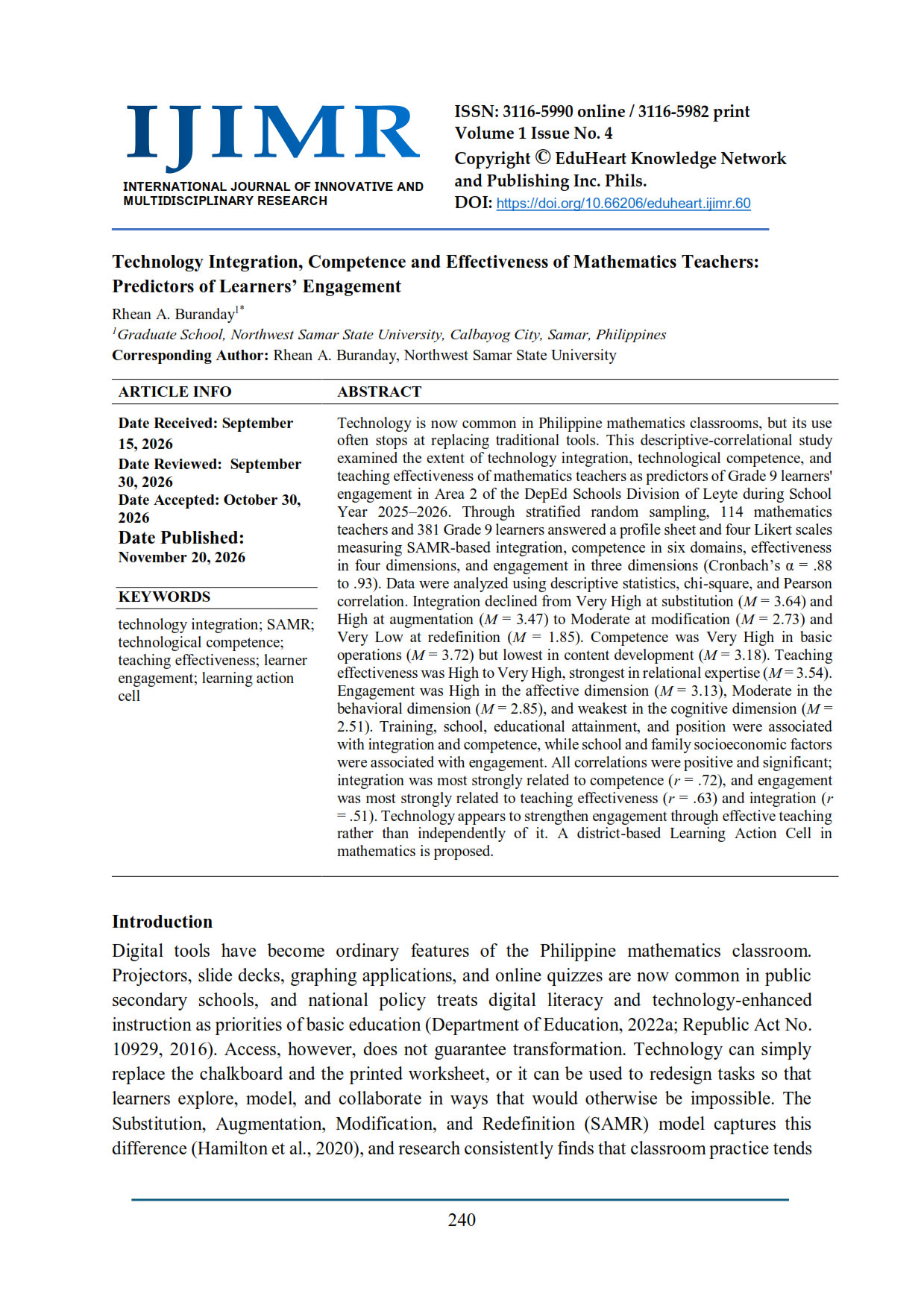
Technology is now common in Philippine mathematics classrooms, but its use often stops at replacing traditional tools. This descriptive-correlational study examined the extent of technology integration, technological competence, and teaching effectiveness of mathematics teachers as predictors of Grade 9 learners' engagement in Area 2 of the DepEd Schools Division of Leyte during School Year 2025–2026. Through stratified random sampling, 114 mathematics teachers and 381 Grade 9 learners answered a profile sheet and four Likert scales measuring SAMR-based integration, competence in six domains, effectiveness in four dimensions, and engagement in three dimensions (Cronbach’s α = .88 to .93). Data were analyzed using descriptive statistics, chi-square, and Pearson correlation. Integration declined from Very High at substitution (M = 3.64) and High at augmentation (M = 3.47) to Moderate at modification (M = 2.73) and Very Low at redefinition (M = 1.85). Competence was Very High in basic operations (M = 3.72) but lowest in content development (M = 3.18). Teaching effectiveness was High to Very High, strongest in relational expertise (M = 3.54). Engagement was High in the affective dimension (M = 3.13), Moderate in the behavioral dimension (M = 2.85), and weakest in the cognitive dimension (M = 2.51). Training, school, educational attainment, and position were associated with integration and competence, while school and family socioeconomic factors were associated with engagement. All correlations were positive and significant; integration was most strongly related to competence (r = .72), and engagement was most strongly related to teaching effectiveness (r = .63) and integration (r = .51). Technology appears to strengthen engagement through effective teaching rather than independently of it. A district-based Learning Action Cell in mathematics is proposed.
Publication record
- DOI
- https://doi.org/10.66206/eduheart.ijimr.60
- ISSN
- 3116-5990
- Published
- 2026-11-20
- License
- https://creativecommons.org/licenses/by/4.0/
- Copyright
- © 2026 International Journal of Innovative and Multidisciplinary Research
- Publisher
- EduHeart Knowledge Network and Publishing, Inc.